

Even while being late to the party, they are still talk of the town for some right and for some wrong reasons.
Have you seen the unfold animation yet?
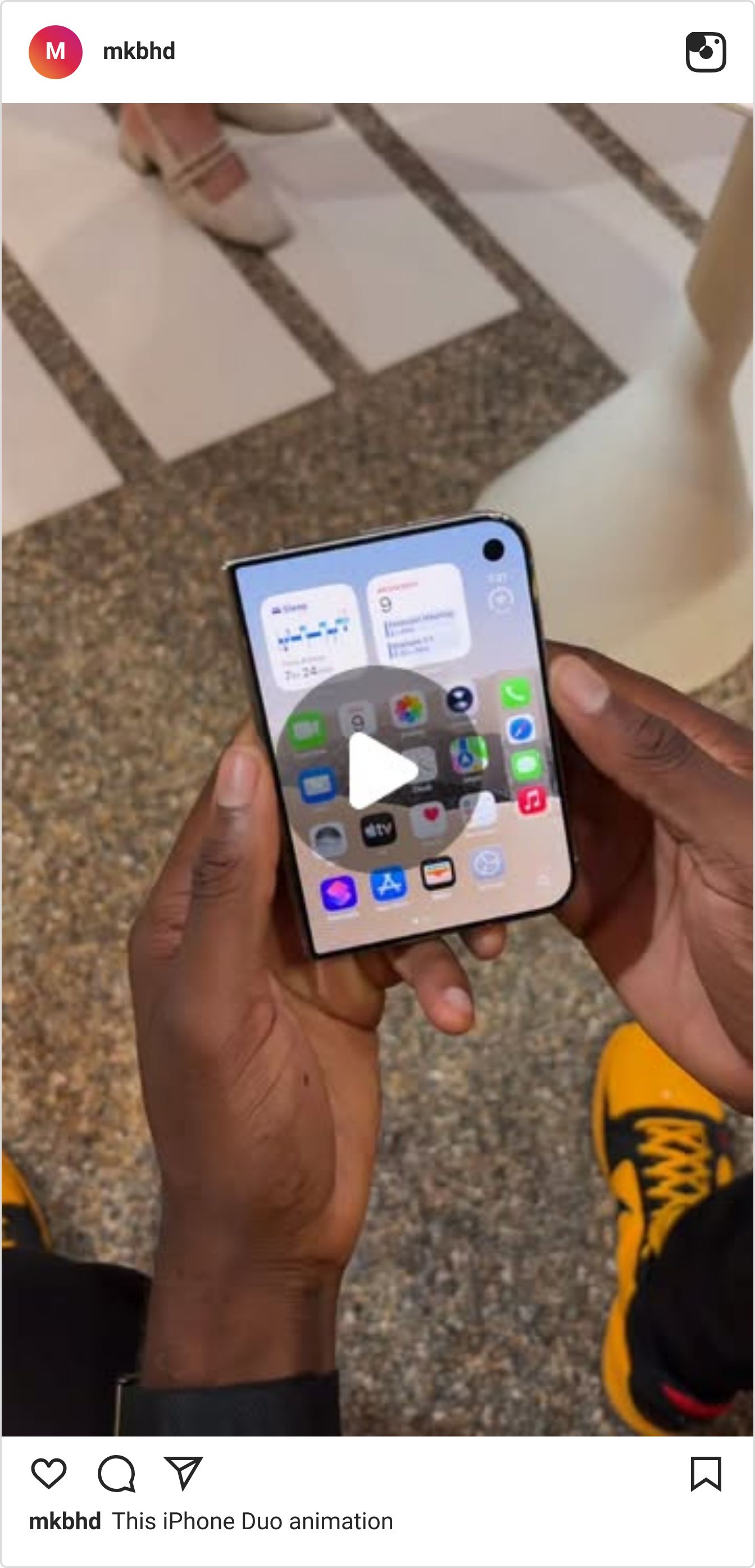
Every other foldable just cuts between the two screens. You open it, the outer display switches off, the inner one switches on. Functional. Slightly jarring. Nobody thought to fix it.
Apple built an actual transition for it. Open the iPhone Duo and your apps stay locked in place while the phone seems to reorient itself around them. The interface blurs and stretches across the crease or the pane. Software following hardware, in real time.
It is genuinely lovely. I've watched the clip more times than I'd like to admit.
And I'm not the only one. Within a day of the keynote, an Android developer had rebuilt that exact effect on a Galaxy Z Fold 8. That's the highest compliment our industry knows how to pay.
The hardware holds up too. The hinge runs on more than 100 precision components, with adhesives that let the display layers slide against each other as it folds. People who've held it say the inner screen looks like paper.
Nobody is talking about the crease. For a first-generation foldable, that's remarkable.
Then you look at the price
₹2,99,900.
That's where it starts. The 2TB is ₹4,49,900.
Here's what I find interesting, though. Scroll through the reaction and almost nobody is arguing about the money. They're sharing the animation.
The price landed and we moved on in about a day.
Why it costs what it costs
This part isn't really Apple's doing.
Memory got obscenely expensive this year. Contract prices for DRAM nearly doubled in a single quarter. Storage went the same direction.
The reason is sitting in a data centre.
Roughly 70% of all memory chips made on earth now go into AI infrastructure. The hyperscalers have pushed the big three memory manufacturers to hand over their limited factory space for enterprise parts. Those are the same factories that make the storage in your phone.
So your phone is bidding against a GPU cluster for the same silicon. The cluster pays more. The cluster wins every time.
SK Hynix's own CEO said in July this probably runs past 2030.
The part I keep thinking about
Everyone's looking at the ceiling. ₹4.5 lakh, look how mad that is.
Look down instead.
When memory costs this much, phone makers have two moves: charge more, or give you less. Most are doing both, and only one of those makes headlines.
Base models are quietly going back to 4GB of RAM. Cameras, speakers and displays are being downgraded on budget phones with no announcement at all.
4GB. In 2026. That was mid-range in 2019.
So the ceiling went up and the floor came down, in the same year. The gap between "a phone" and "a good phone" just got much wider, and nobody ran a keynote about the bottom half.
That's the real story. Not the three lakh phone. The ₹15,000 phone that got worse while you weren't looking.
We adapt by not noticing
Remember when phones crossed ₹1 lakh and everyone lost it? The headphone jack? The charger leaving the box?
Two weeks of noise. Then silence. Then it's just how phones are.
India runs its own version of this, and it's called no-cost EMI.
₹2,99,900 never has to feel like ₹2,99,900. It feels like about ₹12,500 a month. Your brain files that somewhere near a gym membership and stops doing maths.
That's the whole trick. The number never becomes real.
And once the top of the market sits at ₹4.5 lakh, everything below it starts looking sensible. The ₹1.5 lakh phone becomes the reasonable choice. It wasn't reasonable last year. Nothing about it changed except what sits above it.
We don't adapt by deciding. We adapt by not noticing.
Although, this time
There is a crack in that story.
Phone shipments are heading for a record fall this year. People aren't all absorbing the price. Plenty are just holding on to what they have, skipping a cycle, buying refurbished.
That's adaptation too. Quieter, and far more expensive for the industry.
So it's probably both. A small crowd pays three lakh without flinching. A much larger one stops upgrading and runs their phone until it dies.
The bottom line
While we were all watching apps stretch across a crease, the definition of a basic phone quietly got worse.
In eighteen months ₹3 lakh will sound normal, the way ₹1 lakh sounds normal now. We'll have adjusted without ever agreeing to anything.
So the question isn't whether you can afford the Duo. It's whether you noticed the floor moving.
But that's only half of it.
"What the Fold, Apple!" isn't just what you say at the price.
It's also what you say when a company spends a hundred precision components on a hinge. When it builds a custom transition for a moment that lasts half a second, that most people will never consciously notice, on a screen that is about to be closed.
Nobody asked for that. They built it anyway.
Plenty of you will disagree, and that's completely fair ;)
But that kind of obsession over detail is getting rare. That's the part I'd hate to lose, even at three lakh.
Upgrading this year?
If you can wait: wait. Memory isn't getting cheaper before 2027.
If you can't: buy more storage than you think you need. It only gets dearer from here.
Know someone about to drop three lakh on a phone? Forward this. Let them enjoy it with their eyes open.
Catch you in the next Adition!
And if you haven't subscribed yet, do so on @ adition
— Adithya 🚀